Share household chores fairly, and see the split as a number
A live Fairness Score that makes the mental load visible — and balances it for you.
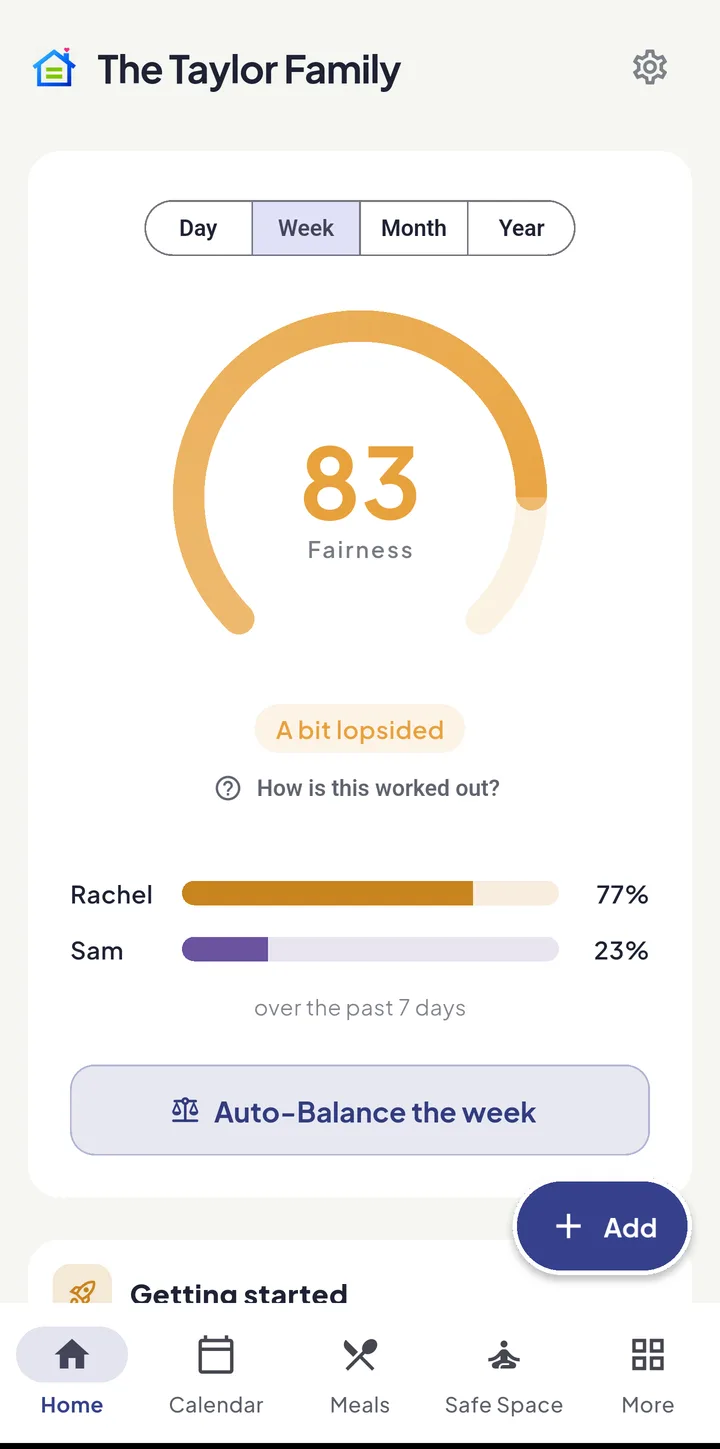
A family organiser keeps the household’s plans in one place. Equal House also measures who is really carrying the home. The Fairness Engine weights every task by effort, allows for who is at work and who is away, keeps unsafe jobs away from children, and turns it into a single score the grown-ups can see and trust. The Fairness Score page explains, with the real numbers, how it is worked out.
- A 0–100 Fairness Score
- One-tap Auto-Balance
- A fairer week ahead, task by task
- Effort, not just count
See it in action
The Fairness Score, explained
How Equal House splits housework by effort rather than by counting tasks: effort weights, the working it shows you, the three colours, and week, month or year.
Read the transcript
Nobody ever wins that argument. So here's a number you can both look at instead.
A big shop isn't a bin bag. Move the difficulty and the time, and the effort points move with them.
Sixty points against twenty-two. That's seventy-three, twenty-seven — not five tasks each.
It allows for how available each of you is, so an uneven split can still score well.
Green from eighty-six, amber from seventy-five, and red below that — worth a conversation.
Week, month or year — and what's shared out, or what actually got done. Check more than one.
Equal House — share the load, fairly.
Auto-Balance and Fairer Week Ahead
The two ways Equal House evens out your week: Auto-Balance shares it out in one tap, and Fairer Week Ahead lists every move for you to tick first.
Read the transcript
Feed the dog, the morning walk, the recycling — all sitting there with nobody's name on them.
One tap and it shares the week out on the spot. Fifty-six tasks, on track for ninety-five.
Every one of them has a name on it now, given to whoever's carrying less.
Fairer Week Ahead lists every move it would make, as tick boxes. Who from, who to, and when.
Untick the ones you don't fancy, and only the rest move. Fifty-five became fifty-three.
Equal House — share the load, fairly.
Why 50/50 isn’t always fair: work schedules
Tell Equal House when each grown-up is at work and it stops expecting the same from both of you, then shows where the hours actually go.
Read the transcript
Seventy-three against twenty-seven, and it still says well shared. Why?
Because the score allows for how available each of you is. A week at work counts.
Set the usual week once — Monday to Thursday, nine to five — and it expects less on those days.
Weeks not all the same? Put the shifts in by date, or read them off a photo of the rota.
And Time Breakdown shows everyone's scheduled time, by the kind of event.
Equal House — share the load, fairly.
The shared family to-do list
One list the whole house can see: ready-made tasks to start from, given to people rather than groups, effort points that make the score honest, and bulk actions.
Read the transcript
Every task in the house, searchable, filtered, with the overdue ones at the top.
Magic Add, a ready-made task, your own, an event, or someone new in the family.
Nobody wants to type 'empty the dishwasher'. Tick a few, and Auto-Balance shares them out.
Pick who it's for. Or leave it to anyone, and Auto-Balance decides.
The effort points are what the fairness score actually counts. Not the number of ticks.
Select turns the bottom bar into Delete and Mark complete.
Equal House — share the load, fairly.
What you get
A 0–100 Fairness Score
Every task feeds an effort-weighted ledger, and the result is one number for how evenly the grown-ups share the home. 86 and above is green, 75 to 85 is amber and under 75 is red: a sign the home has tipped onto one person, not a verdict on anyone.
One-tap Auto-Balance
Tap Auto-Balance and the engine shares out the upcoming chores straight away — there is no preview to approve — onto whoever is carrying least and is genuinely free, never offering a child a job that is not safe for them. It then tells you how many it shared out and the score the week should reach. It only moves jobs that are not done yet.
A fairer week ahead, task by task
When you would rather choose, More → Fairer Week Ahead looks at the coming week and suggests which jobs could move, and to whom. Accept the ones you agree with — nothing moves until you say so — and it tells you where the week is heading without naming anybody.
Effort, not just count
Bathing the kids is not the same as emptying a bin. Tasks carry effort weights, so five quick jobs never hide one exhausting one. The 53 everyday jobs in our household chores list come to about 26 hours a week between you.
Away days skipped, work allowed for
Mark someone away and Auto-Balance gives them no work on those days, so no chore lands on a person who is on a work trip or away for the weekend. Being away does not lower what the score expects of them, though; only a work pattern does that.
Work patterns and shifts built in
Set each adult’s weekly hours, or their real shifts by date — nights included. Save the shifts you work, such as an early or a night shift, and put one on as many days as you pick at once. The engine expects less of someone while they are at work, and while they sleep after a night shift, so a full-time job isn’t quietly punished with a full load of chores too.
Fairness over time
Switch the score between Week, Month and Year to tell a short blip from a longer pattern, rather than seeing this week in isolation.
Thanks, not trophies
Your Week in Review counts what you got done between you and names no winner, and a Thanks chip on a job your partner has just finished makes saying so one tap.
Children counted separately
The score is about the grown-ups. A child’s jobs are counted on their own Kid Zone board, as stars and pocket money, and never scored. Reassigning and declining respect each member’s role, so a task meant for an adult is never handed to a child.
How-tos and guides
In the app
Keep exploring

Share the home. Lighten the load.
Join the families using Equal House to split chores, childcare and the mental load fairly — and finally feel like a team again.


Free to start on your iPhone Free to start on your Android phone Free to start · No ads · Your family's data stays yours.